Start from your sky
Sunset, darkness, altitude, Moon, weather and sky-quality data are evaluated for the location and night you selected.
NightScope turns your location, equipment and sky conditions into a practical plan for visual observing and astrophotography.
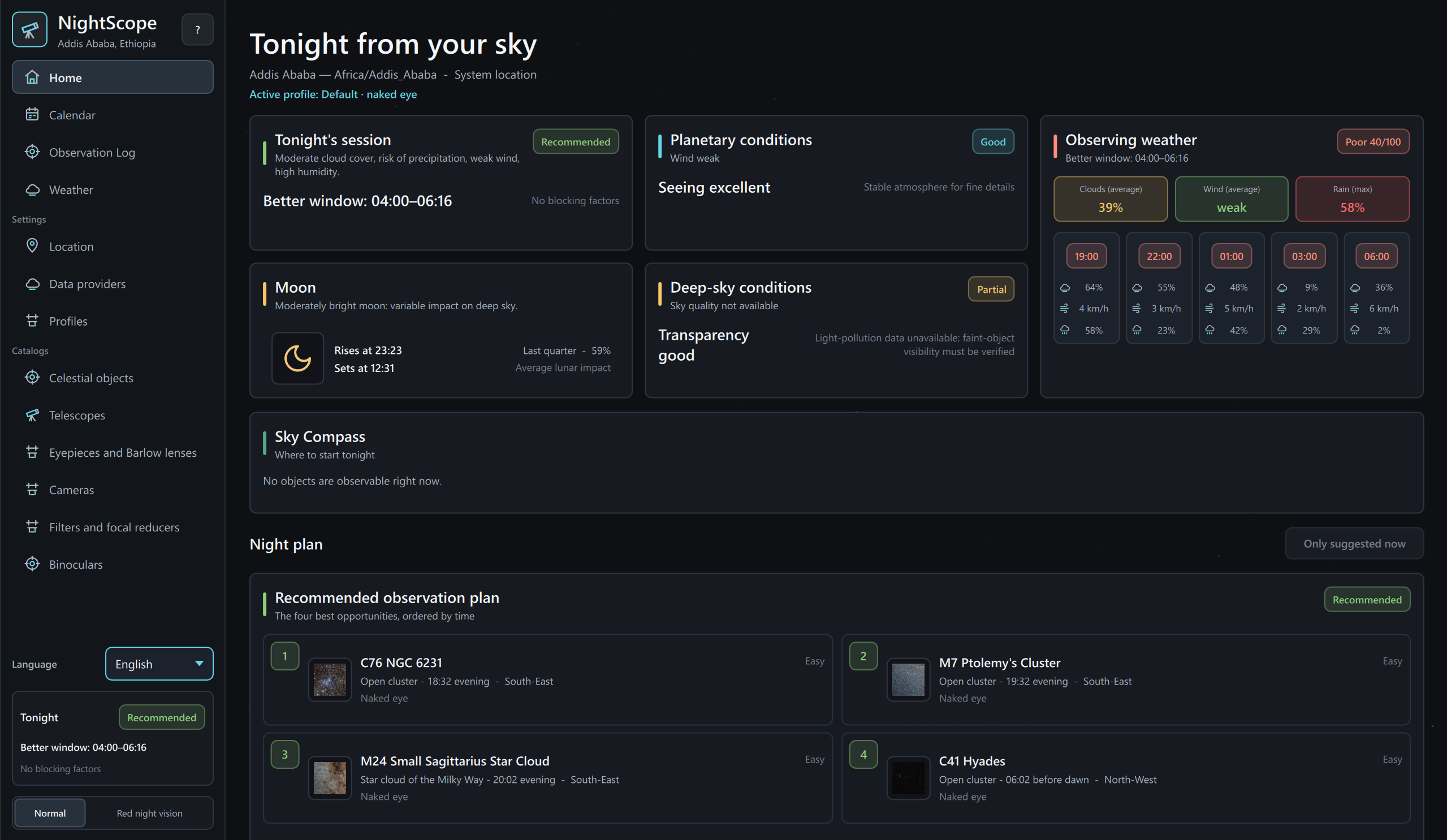
NightScope combines astronomical geometry, local forecasts and your real equipment, then presents useful windows and limiting factors in plain language.
Sunset, darkness, altitude, Moon, weather and sky-quality data are evaluated for the location and night you selected.
Telescopes, binoculars, eyepieces, cameras and smart telescopes are considered without inventing compatibility that was never declared.
See what is worthwhile, when to observe it, what may get in the way and which configuration best fits the target.
Recommendations stay practical and transparent: missing data remains missing, uncertainty is visible and visual observing never gets mixed with the photographic path.
A short time-ordered plan, useful observing windows and alternatives for the target you want to see.
Compare the instruments in your active profile and receive concrete telescope, eyepiece and optical-train context.
Camera field, sampling, still-exposure planning and Solar System video guidance remain separate from visual ranking.
Directional guidance helps you move from the plan to the right area of the sky when a recommended target is observable.
Annual events, visible ISS passes and multi-night comet windows live together without being forced into object scores.
A persistent low-luminance red interface protects dark adaptation, while observations and equipment remain stored locally.
Explore Solar System, Messier, Caldwell and NGC targets. Curated Messier and Caldwell entries include descriptions, observing notes, scientific facts and credited imagery.
Each platform package is validated and released independently, so the current Windows and Linux version numbers are intentionally different.
Extract the archive into a writable folder and run NightScope. Your database, preferences and personal images stay beside the application.
Get Windows releaseDownload the tarball and its adjacent SHA-256 file. Desktop Qt, D-Bus, GeoClue and Secret Service dependencies remain host services.
Get Linux releaseWindows 1.47.0 adds practical observing windows, IMO meteor calendars, local meteor windows, COBS comet guidance and faster database startup. Linux remains at 1.43.0 and does not yet include these improvements. Version numbers refer to published packages; development source may be newer.
Windows 1.47.0 was released on September 20, 2026. COBS comet guidance uses qualified recent observations and retains JPL predictions when data are unsuitable. COBS data use CC BY-NC-SA 4.0 for noncommercial use; NightScope code remains MPL 2.0.
NightScope is licensed under MPL 2.0. The repository includes setup, architecture, testing, data-provenance and packaging documentation.
NightScope is deliberately focused: it supports planning decisions and leaves sky-chart and hardware-control work to dedicated tools.
No. NightScope is a decision-support planner. It recommends targets, time windows and equipment context; it is not a star atlas, mount controller or substitute for safe observing practice.
No NightScope account is required. Core astronomical calculations and the celestial catalogue are local. Optional weather and environmental providers need internet access, and some offer their own credentials.
The portable bundles are built, audited and published independently. Windows currently has version 1.47.0; the latest public Linux package remains version 1.43.0 until a newer Linux bundle completes validation.
Start with the multilingual user manual or explore the technical documentation in the GitHub repository.
Download NightScope for free, build your equipment profile and let the next useful observing window become obvious.